Ag Industry Responds to Trump’s Emissions Comments & Interest Rate Cut

In this episode of On the Record, brought to you by Associated Equipment Distributors, we take a look at how removing emissions controls from farm equipment could impact the market — from cost of equipment to what it means for the used market. In the Technology Corner, Noah Newman has a report from AGRITECHNICA on AEF’s newest launch. Also in this episode, a discussion on how the latest interest rate cut will impact ag, including perspective from lenders, manufacturers and farmers.
This episode of On the Record is brought to you by Associated Equipment Distributors — the leading association in North America for the equipment distribution industry. Don’t miss the 2026 AED Summit – January 19–21 in Dallas, TX!
This is the premier event built exclusively for the equipment distribution industry. For three action-packed days, thousands of industry leaders come together to connect, collaborate, and unlock new opportunities. Discover hundreds of manufacturers actively seeking distribution and service partners across every area of dealership operations—from financing and software to insurance and beyond. It’s the only event designed by and for equipment dealers that has over 40 education sessions, 4 thought leadership keynote speakers, and over 200 exhibitors to meet with to shape the future of your business — and it’s your chance to be at the center of it all.
Learn more and register today at www.aedsummit.com. Interested in discounted registration options? Contact jcruthers@aednet.org to discover how you can get reduced registration rates to attend this event.
TRANSCRIPT
Jump to a section or scroll for the full episode...
- Market Impact of Removing Emissions Controls from Ag Equipment
- Dealers on the Move
- A Big Step Forward for Interoperability & Data Sharing
- Tracking Crop Prices
- Fed Cuts Another Quarter Point
- Used Equipment Sales See an Uptick
- DataPoint: Machinery Costs Per Acre for Small & Large Producers
Market Impact of Removing Emissions Controls from Ag Equipment
During the Trump administration's announcement on Dec. 8, 2025 about the $12 billion aid package for farmers, he called for farm equipment manufacturers to lower prices “because farming equipment has gotten too expensive.”
In his comments, Trump took aim at the emissions controls and said all they do is make equipment more expensive. Trump said they were going to let John Deere and the other manufacturers remove those controls.
In an interview with Fox Business, Deere’s CFO Josh Jepsen pushed back gently on Trump’s claim that regulations alone are driving up tractor prices, “saying the true path to lowering costs for America’s farmers lies in cutting-edge tech — from AI weed detection to digitized acres — that can save growers money long before the rule books change.”
Tim Brannon, owner of B&G Equipment, said Trump “pulled the pin and dropped a grenade on the farm equipment industry when he said we are going to remove emission controls.
He says:
“At least, that is what we think we heard. One industry source commented 'we are coming apart at the seams'. What was meant were the possible repercussions of such a move. The underlying premise is the emissions systems on diesel engines are not reliable; they are finicky, fragile and most of all costly. The removal will be a godsend to all except those who make the emission equipment. Whoever comes to market first with non-emission power will have a real chance at grabbing a huge chunk of the market.”
He goes on to say that the reality is that you can’t just remove the emissions systems, whether that is DEF or a particulate filter. It will take time to re-engineer the systems and bring them to market.
While the perception may be that these units would be cheaper, Brannon says in reality that’s likely not the case. At this point, there are likely more questions than answers, but Brannon says at his dealership the reception so far has been positive from everyone, customers included.
One question that has popped up in response to Trump’s statement is what impact could this change have on the used equipment market.
Josh Peddycord, Regional Sales Manager for Ritchie Bros. Auctioneers, says if the change is made the far bigger concern would be what it would do to the used market.
He says,
“It's no secret that there is a glut of used equipment out there and dealers are already struggling to move this gear. Ironically, used values are strongest when new machines are expensive and complex.”
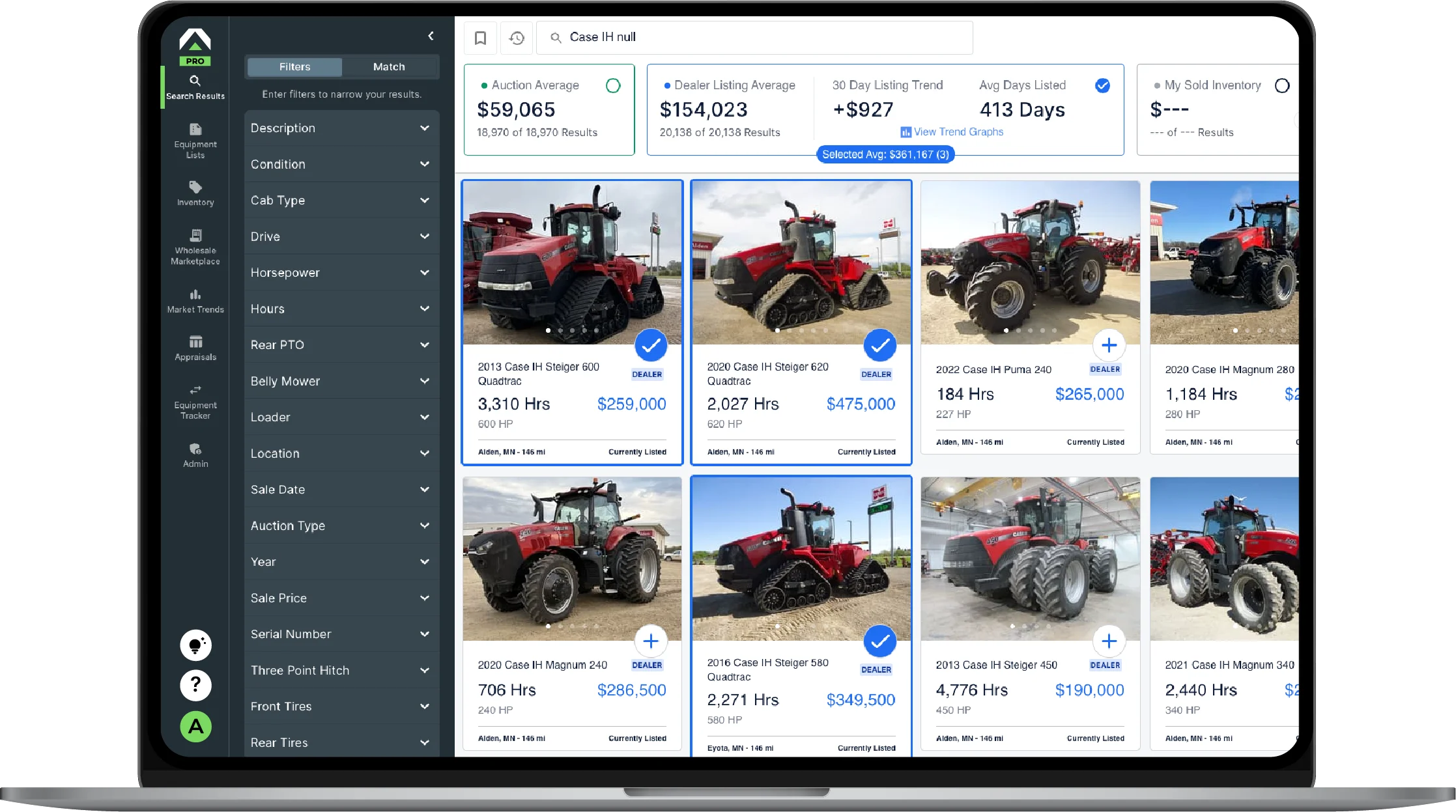
We also checked in with Tractor Zoom’s Andy Campbell for his perspective on the impact to the used market.
"There is a lot of aged equipment sitting on dealership lots right now, and those, they wouldn't sell. So who would want to buy a one or two-year-old late model piece of equipment at a exact same or even a higher price than a brand new piece of equipment without this DEF problem in it? Implications to equipment dealers, whoever's left holding that bag of that DEF equipment, oof, that would be a major hit."
As Tim Brannon pointed out, hopefully the “grenade dropped was a practice model that spurs organized, welcome relief instead of an explosion that further destroys a depressed market.”
Dealers on the Move
This week’s Dealer on the Move is Rocky Mountain Equipment.
The Canadian Case IH and New Holland dealer acquired New Holland dealer Agri-Centre, adding stores in Linden and Stettler, Alberta.
A Big Step Forward for Interoperability & Data Sharing
We had a front-row seat to the launch of AEF’s Agricultural Interoperability Network (AgIN) at AGRITECHNICA a few weeks ago, which promises to ease the process of data sharing for farmers and dealers.
“AgIN is a new standardized global gateway that, for the first time, connects equipment manufacturers, data hubs, Farm Management Information Systems, and service solutions to enable trusted-manufacturer independent and brand-agnostic data sharing,” according to AEF.
Slawi Stesny, AgIN team lead, says the goal is to make the data exchange between systems easy, lean and efficient.
“So, business to business. We expect participants in this environment have their own platforms. They integrate these interfaces once, having one API to all the others. Not having the need to maintain all of these individual APIs anymore. This reduces complexities, making it easier for the farmer to use their equipment of choice and software of choice, and not have the issues of two solutions that don’t interoperate anymore with each other.”
The new interoperable network will become operational next year, with a staged release planned for March, and the production release in September, 2026.
Tracking Crop Prices
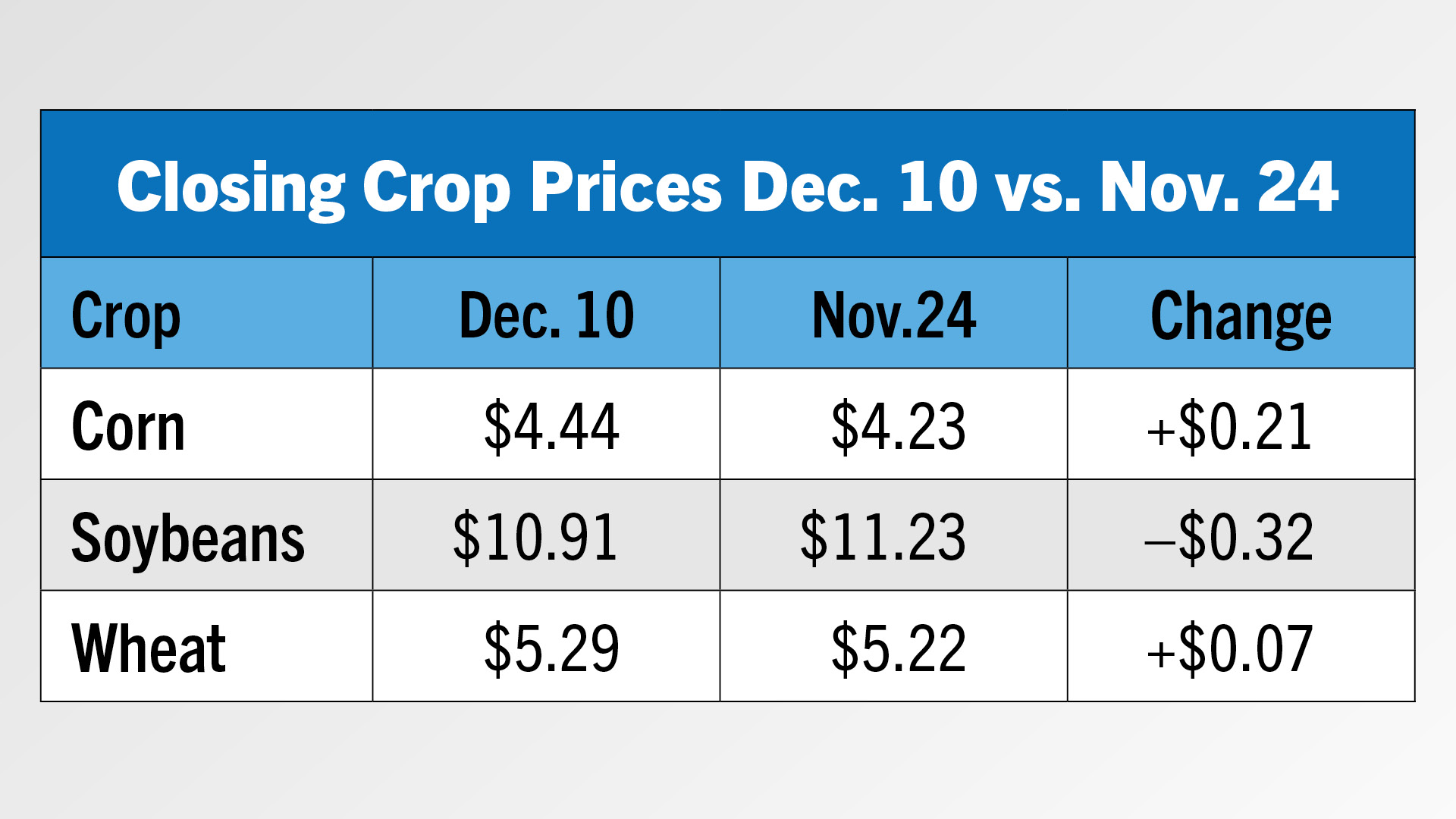
As of December 10, corn prices were $4.44, up 21 cents from our last episode. Soybeans closed at $10.91, down 32 cents. And wheat closed at $5.29, up 7 cents.
Fed Cuts Another Quarter Point
On Dec. 10, the Federal Reserve announced another quarter point rate cut, lowering it to 3.5-3.75%.
Similar to the cut made in October, the Federal Reserve Open Market Committee said it “seeks to achieve maximum employment and inflation at the rate of 2% over the longer run.” The statement went on to say that uncertainty about the economic outlook remains elevated, and the committee is attentive to the risks on both sides of its dual mandate and judges that downside risks to employment rose in recent months.
I checked in with AgDirect’s Greg Roberg to get some perspective on what this latest cut means for farm equipment dealers and their customers and the impact it could have on 2026.
"This has been a good week for some good news for production agriculture, dealers, farmers, lenders, anybody that's in the industry. We got the announcement earlier this week that the Trump administration is going to send out checks here at the end of February in the neighborhood of 11 to 12 billion to producers across the country to help bridge that gap where commodity prices have been down, which may be impacted by tariffs, likely are, with some of the trade talks we have with some of our international partners. That was some good news."
"And then, of course, with interest rates. Now you got to kind of temper your expectations when interest rates are lowered. And what I mean by that is this is short-term money. So at its core, these are borrowing costs that banks, lenders can borrow overnight. It's called Fed funds. And so that sets that rate, and then prime is always 3% over. So we went from 4% Fed funds rate to 3.75 yesterday. So we'll see prime go to 6.75 today. Prime is always 3% over whatever the Fed funds rate is. So that's good news. So that means short-term operating is going to be cheaper."
The rate cut announcement came while our editors were visiting Yetter Farm Equipment. Andy Thompason, regional sales manager, provided some perspective on what the cut means to the manufacturing and equipment inventory retail side of the business.
“From a sales standpoint, the easiest thing is we just stop, because the sales are not there. But then the optimism is we want to be ready to roll when people are ready to start purchasing. There's a lot of things that have to happen in between that. And so carrying costs and inventory, I mean, that inventory, somebody owns inventory. And retailers, manufacturers, suppliers, whatever, somebody's always got to own that inventory right there. And so, we're in business the same as every farm is. We've got to be able to generate positive income, and we've got to be able to sustain. We know when we're not seeing that. And so the same thing, I mean, that's one of those factors that is going to have a trickle down all the way from the actual raw manufacturers, all the way down to the end users.”
We also stopped at Bottons Farm in Cambridge, Illinois, to visit with Monty Bottons. Here's what he had to say from the farmer's perspective.
"You look at how much it's cost to produce an acre of corn or soybeans, how much that cost has increased in the last 10 years, is it double, Mike? I mean, it's probably nearly double those inputs in there. So all of that requires additional working capital, which typically is from operating notes. So we've doubled our interest expense, and as those percentages go up, that eats into our bottom line even more."
"Look at what equipment prices have done. 10 years ago, was there a million dollar combine? There is today. And you take that times a quarter point on a million dollar note, that gets to be some serious money pretty quick. So anything there to help with the liquidity of the farm and be able to make working capital more available is always welcome; anything that can help us on the mid-range debts associated with farm equipment is welcome."
"And the other thing that'll do is it'll improve the balance sheet of farmers who own land or long-term assets, because as interest rates go down, typically land values go up, which then gives them more ability to flex their balance sheet to do additional acquisitions for equipment and those kind of things, because they have a larger base in order to borrow from."
In the 2026 Dealer Business Outlook & Trends report, dealers ranked interest rates impact on customers’ purchases No. 8 on their list of top concerns, down from No. 1 in the 2025 report. As it relates to interest rates impact on dealer finances, dealers ranked it No. 9 on the list.
Used Equipment Sales See an Uptick
According to Sandhills Global’s Dec. 4 market report, used equipment sales are on the rise. TractorHouse Manager Ryan Dolezal explains, “With the end of the year approaching, sales are starting to tick up, leading to some optimism for the end of the year. However, sales are slower compared to past years, so it’s still vital to price competitively.”

Inventory levels for U.S. used tractors with 100-plus horsepower continued a 7-month-long downward trend in November, with decreases of 3.4% month-over-month and 14.6% year-over-year. Tractors over 300 horsepower saw the most significant month-over-month inventory level drop at down 3.8%, while 100-174 horsepower tractors saw the steepest annual decline with a 22.1% drop.
Asking prices decreased by 1.3% month-over-month and 5.5% year-over-year, continuing a trend for the 10th consecutive month. The largest changes occurred in the used 175-299 horsepower tractor category, with asking values down 2.8% month-over-month and 5.3% year-over-year.
DataPoint: Machinery Costs Per Acre for Small & Large Producers
This week’s DataPoint is brought to you by the Precision Farming Dealer Summit, coming to St. Louis Jan 5-6. To download the program and to register visit precisionsummit.com.
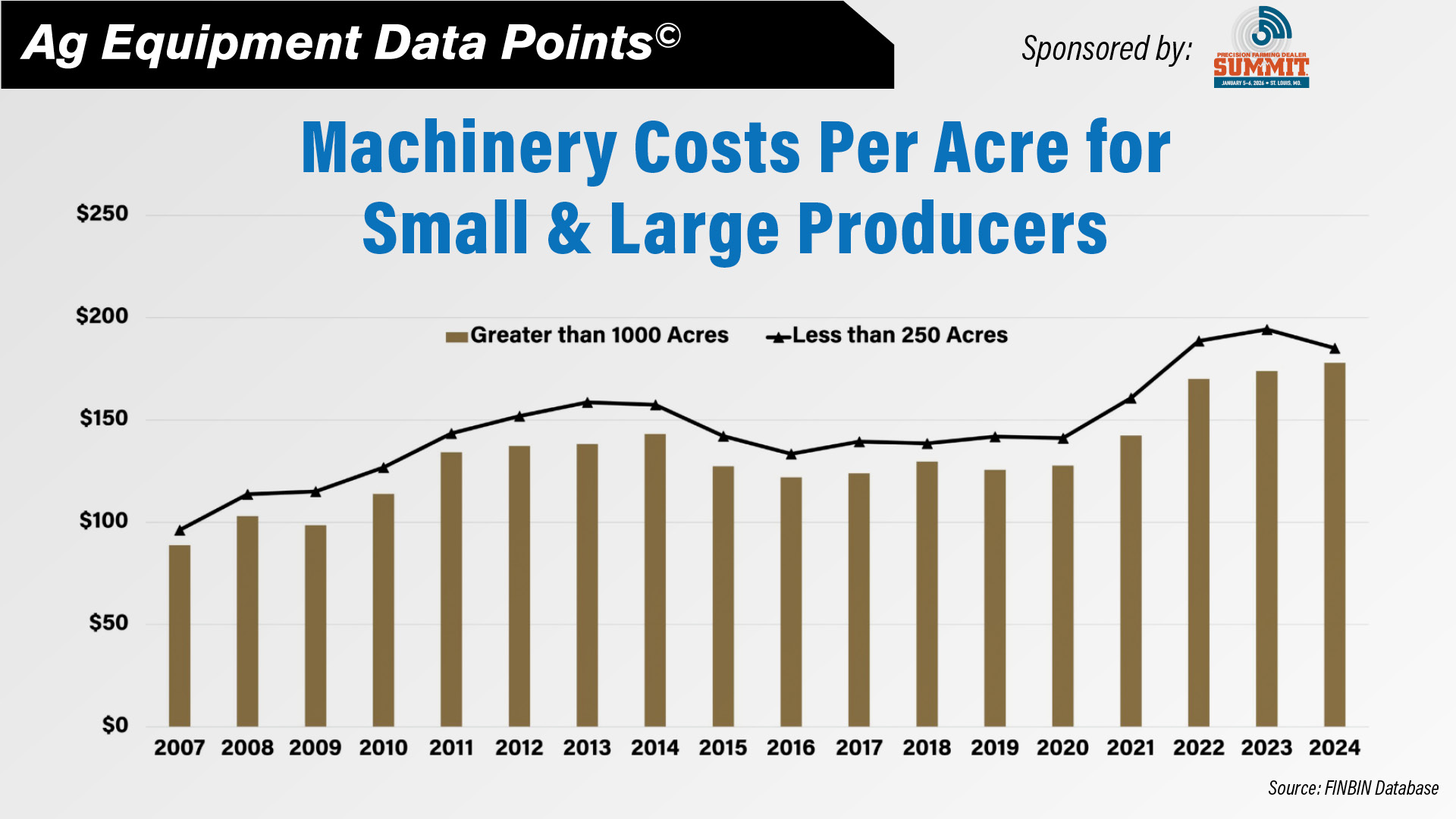
This chart from Michael Langemeier and from Purdue University’s Center for Commercial Agriculture illustrates the trend in machinery cost per acre for small and large corn producers. Since 2021, machinery cost per acre for producers with over 1,000 planted acres of corn or soybeans has increased 25% for corn and 22% for soybeans. There was a significant difference in machinery cost per acre for corn or soybean enterprises with less than 250 acres and more than 1000 acres over the time period. The average difference over the period was $14 for both corn and soybeans (i.e., 9.6% for corn and 15.1% for soybeans), suggesting that there are economies of scale related to machinery cost per acre.

Join the future of ag & heavy equipment sales
Take a guided tour of Tractor Zoom Pro and Anvil Pro to discover how wider margins and faster turns are just a few clicks away.